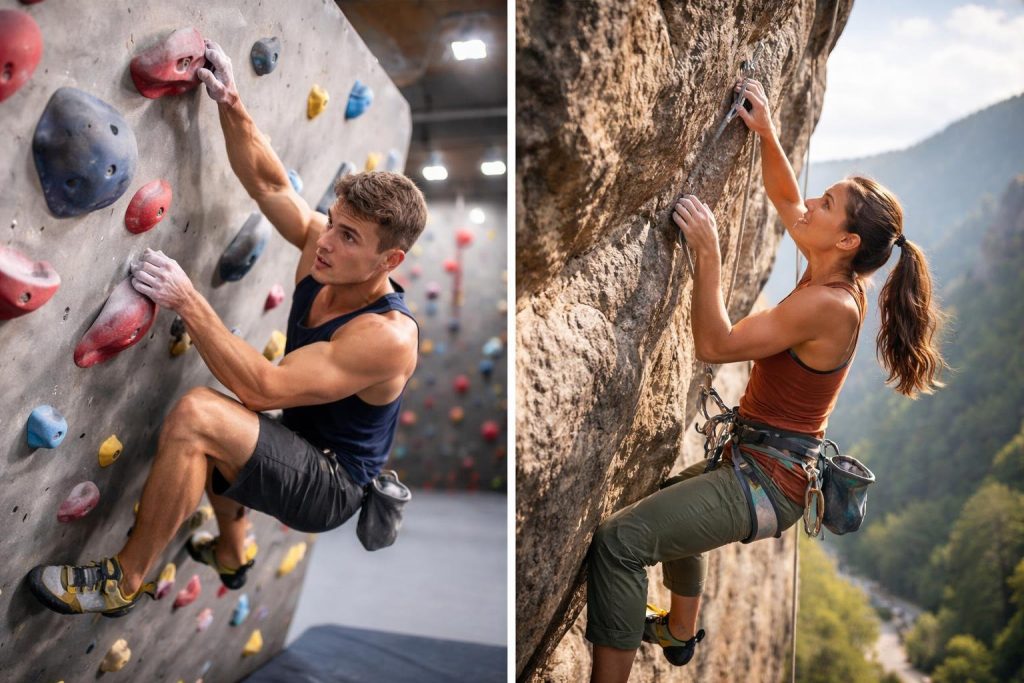
If you’ve ever walked into a climbing gym and seen climbers debate whether a problem is “V4” or “V5,” you were hearing the V Scale in action. The V Scale is a grading system that ranks bouldering problems from V0 (easiest) to V17 (hardest), helping climbers understand how difficult a route will be before they try it. Created by John “Vermin” Sherman in the 1990s, this system has become the standard way to rate bouldering difficulty across North America.
The V Scale gives climbers a common language to talk about their progress and compare routes at different gyms or outdoor areas. Each grade represents a step up in difficulty based on factors like hold size, body positions required, and overall strength needed. Understanding how this system works helps climbers set realistic goals and track their improvement over time.
Bouldering grades aren’t perfect, and climbers often disagree about what grade a problem deserves. But the V Scale remains the most widely used system for a good reason. It provides a useful framework that helps both beginners and experienced climbers navigate the world of bouldering.
Key Takeaways
- The V Scale rates bouldering problems from V0 to V17 based on difficulty level
- John Sherman created the V Scale in the 1990s, and it became the standard grading system in North America
- Bouldering grades are subjective and can vary between gyms and outdoor locations
What Is the V Scale in Bouldering?
The V Scale is a grading system that rates the difficulty of bouldering problems from V0 (easiest) to V17 (hardest). It originated at Hueco Tanks in Texas and has become the standard system for rating boulder problems in North America and many other countries.
Definition and Purpose of the V Scale
The V Scale serves as the primary bouldering grading system in the United States and several other climbing areas worldwide. It helps climbers identify which problems match their skill level before attempting them.
The scale uses a simple numbering system that starts at V0 for beginner problems. As the numbers increase, the difficulty rises significantly. Advanced climbers typically work on problems rated V10 and above, while most intermediate climbers focus on grades between V3 and V7.
The V-Scale differs from rope climbing grades because bouldering problems are shorter but often more intense. A single bouldering problem might only be 10 to 15 feet tall, but it can require maximum strength and technical skill for just a few moves.
Understanding V Scale Notation
The V Scale uses the letter “V” followed by a number to indicate difficulty. Beginner grades start at V0, with some gyms using VB (V-Basic) for the easiest problems.
The scale progresses through whole numbers: V0, V1, V2, V3, and so on. Unlike some other grading systems, the V-Scale does not use letter modifiers or plus/minus signs. A problem is either V5 or V6, with no V5+ designation.
The current top end of the scale reaches V17, though only a handful of climbers have completed problems at this level. Most climbing gyms feature problems ranging from V0 to V10.
Who Created the V Scale?
John Sherman created the V Scale in the late 1980s and early 1990s at Hueco Tanks State Park in Texas. The “V” stands for “Vermin,” which was Sherman’s climbing nickname.
Sherman developed this system because existing rock climbing grades didn’t work well for short, powerful boulder problems. Hueco Tanks featured numerous challenging boulders that needed a dedicated grading system to help climbers communicate about difficulty.
The Hueco Scale, as it’s sometimes called, quickly spread beyond Texas as climbers adopted it in other bouldering areas. Today, it competes primarily with the Font scale used in Europe.
Key Characteristics of the V Scale
The V Scale is open-ended, meaning new grades can be added as climbers complete harder problems. This flexibility has allowed the system to remain relevant as climbing standards have improved over the decades.
Key features include:
- Consistent difficulty jumps between grades
- Focus on the hardest single move or sequence
- No upper limit on the scale
- Wide adoption in North America and parts of Asia
The system rates bouldering problems based on their most difficult section rather than overall length. A V7 problem might have one extremely hard move, while another V7 could have several moderately difficult moves. Both receive the same grade despite feeling different to climbers.
History and Origins of the V Scale
The V Scale was created in the 1990s by climber John Sherman at Hueco Tanks in Texas. The system started with grades from V0 to V10 and has since expanded to V17 as climbers have pushed the limits of the sport.
The Role of Hueco Tanks in Grading Systems
Hueco Tanks State Park in Texas became a major climbing destination in the 1980s and 1990s. The area featured hundreds of short, difficult boulder problems that needed a better grading system.
Before the V Scale, climbers used different systems that didn’t work well for bouldering. The B-System existed but caused confusion because it didn’t clearly show difficulty differences between problems.
Hueco Tanks provided the perfect testing ground for a new system. The concentrated area of boulders lets climbers compare problems directly. This made it easier to create consistent grades that other climbers could understand and trust.
John Sherman and His Influence
John Sherman, also known as “Vermin,” developed the V Scale while climbing at Hueco Tanks. He published the system in his 1991 guidebook for the area.
Sherman designed the scale to be simple and open-ended. He used his own abilities as a reference point, rating problems he could barely complete as V10. The system used whole numbers without plus or minus grades at first.
The climbing community adopted the V Scale quickly. It spread beyond Hueco Tanks as climbers found it more practical than existing systems. Sherman’s influence helped establish bouldering as a distinct discipline with its own standards.
Expansion From V0 to V17
The original V Scale ranged from V0 to V10. As climbers got stronger and techniques improved, harder boulder problems required new grades.
The scale expanded upward throughout the 2000s and 2010s. V11 through V15 were added as elite climbers completed increasingly difficult problems. The first V16 was established in the early 2010s.
In 2021, climbers proposed the first V17 for exceptionally hard problems. The scale remains open-ended to accommodate future advances in climbing ability. Lower grades like V0 serve as entry points for beginners, while the upper grades continue to expand as needed.
How the V Scale Works
The V Scale assigns grades based on the hardest move or sequence on a boulder problem, with route setters evaluating multiple factors to determine difficulty. Grades start at V0 and currently extend beyond V17, with each level representing a significant jump in physical and technical demands.
What Determines a V Grade?
A V grade reflects the difficulty of the crux, which is the hardest section of a boulder problem. Route setters consider the most challenging move or sequence when assigning a grade, not the average difficulty of the entire climb.
Several factors influence the final grade. Hold size and type matter because smaller or more awkward holds require greater finger strength. The distance between holds affects how much reach and body tension a climber needs. Wall angle plays a role since overhanging sections demand more power than vertical walls.
Movement complexity also impacts grading. Problems requiring specific techniques like heel hooks or precise footwork typically receive higher grades than those relying on basic moves alone.
The Grading Process and Role of the Route Setter
Route setters create boulder problems and propose initial grades based on their experience. They test climbs themselves and observe other climbers attempting the problem. This feedback helps confirm or adjust the grade.
The consensus method is common in climbing gyms and outdoor areas. Multiple climbers try a problem and share their opinions on the difficulty. If most climbers agree the grade feels accurate, it sticks. If many climbers find it easier or harder than expected, the route setter may change the grade.
Grades can shift over time. Holds wear down or break, making problems harder. Beta (movement sequences) spreads among climbers, sometimes making problems feel easier.
Physical and Technical Demands at Each Grade
Lower grades like V0, V1, and V2 use large holds on vertical or slightly overhanging walls. Climbers need basic strength and learn fundamental techniques like proper foot placement.
V3, V4, and V5 introduce smaller holds, steeper angles, and more complex sequences. Climbers encounter their first serious power moves and technical challenges such as heel hooks.
V6 and V7 require significant finger strength and body tension. Problems at these grades often feature sustained difficulty with multiple hard moves in a row.
Elite grades like V16 and V17 demand years of training and near-perfect execution. These problems combine extreme power, precision, and endurance in ways that only a handful of climbers worldwide can complete.
V Scale Grades Explained: Difficulty Progression
The V Scale ranges from V0 to V17, with each grade representing a significant step up in technical difficulty, strength requirements, and problem-solving complexity. Climbers typically spend months or even years progressing between grades as they develop new skills.
Beginner Bouldering Grades: V0–V2
Beginner bouldering grades introduce climbers to basic movement patterns and fundamental techniques. V0 problems feature large, easy-to-grip holds and straightforward sequences that require minimal strength. Most people with average fitness can complete V0 routes after learning basic climbing safety.
V1 introduces slightly smaller holds and requires climbers to use basic footwork more deliberately. The problems may include simple overhangs or require climbers to reach between holds with more precision.
V2 represents the upper end of beginner bouldering. These problems demand better body positioning, basic footwork techniques like edging, and some finger strength. Climbers often spend several weeks or months working from V0 to V2 as they build foundational skills.
Key characteristics of beginner grades:
- Large, positive holds
- Minimal overhangs
- Short sequences (4-8 moves)
- Focus on basic technique over strength
Intermediate and Advanced: V3–V8
V3 through V5 mark the intermediate range where climbers must develop specific techniques like heel hooks, toe hooks, and dynamic movements. V3 problems introduce smaller holds and steeper angles. V4 and V5 require significantly more finger strength and body tension.
V6 and V7 represent advanced climbing where refined technique becomes essential. These grades demand strong fingers, core strength, and the ability to read complex sequences. Climbers at this level typically train specifically for climbing and have developed years of experience.
V8 sits at the boundary between advanced and expert climbing. Problems at this grade often include powerful movements, small crimps, or sustained sequences that test endurance. Most climbers need 3-5 years of consistent practice to reach V8.
Expert to Elite: V9–V17
V9 through V12 define expert-level bouldering that requires dedicated training and natural aptitude. These problems feature demanding moves on tiny holds, complex body positions, and sequences that require perfect execution.
V13 and above represent elite climbing achieved by only a small percentage of boulderers worldwide. V16 and V17 include the hardest boulder problems ever completed. These grades require years of specialized training, exceptional genetic advantages, and near-perfect technique.
Only a handful of climbers have completed problems graded V17. The difficulty gap between each grade becomes more pronounced at elite levels, with years of training often needed to progress a single grade.
Comparing the V Scale With Other Bouldering Grading Systems
The V Scale is just one of several bouldering grading scales used around the world. Different regions and climbing communities have developed their own systems, with the Fontainebleau scale being the most common alternative, while sport climbing uses separate grading methods entirely.
V Scale vs. Fontainebleau Scale (Font Scale)
The Fontainebleau scale, often called the Font scale, originated in the famous bouldering area of Fontainebleau, France. This system uses numbers combined with letters (a, b, c) and sometimes a plus sign to indicate difficulty.
Font grades start at 1 and progress upward, with subdivisions making the scale more precise than the V Scale. For example, a Font grade might read as 6B+ or 7A.
The V Scale tends to have broader grade bands, meaning each V grade covers a wider range of difficulty. A single V grade might equal two or three Font grades. For instance, V5 roughly corresponds to Font 6C/6C+, while V6 aligns with Font 7A.
Most outdoor bouldering guides in Europe use the Font scale. Climbers traveling between the United States and Europe need to understand both systems to accurately assess problems.
V Scale and the Yosemite Decimal System (YDS)
The Yosemite Decimal System (YDS) grades sport climbing routes, not boulder problems. Sport climbing grades in the YDS use the format 5.X, where X represents the difficulty level.
Comparing boulder grades to sport climbing grades is difficult because the activities differ significantly. Sport climbing involves longer routes with endurance requirements, while bouldering focuses on short, powerful sequences.
Generally, a boulder problem rated V5 might feel similar in difficulty to a sport climbing route graded 5.12a or 5.12b. However, this comparison breaks down at higher levels because the skills required diverge. A climber who excels at bouldering might struggle with the endurance needed for sport climbing, even at equivalent difficulty levels.
Indoor vs. Outdoor Bouldering Grades
Climbing gyms and bouldering gyms often set grades differently than outdoor bouldering areas. Indoor grades can vary significantly between facilities because each gym has its own setting team and philosophy.
Some bouldering gyms grade easier to encourage beginners, while others maintain strict grading standards. A V4 at one gym might feel like a V2 or V6 at another facility.
Outdoor bouldering grades tend to be more consistent because they’re established by community consensus over time. Classic problems in popular areas have grades that reflect decades of climber feedback.
Indoor bouldering also uses colored holds or tags instead of natural rock features, which changes how climbers read and approach problems. Many gyms display both V Scale and Font grades to accommodate different climber preferences.
Grade Conversion and Limitations
Grade conversion charts help translate between the V Scale, Fontainebleau scale, and other bouldering grading scales. These charts provide approximate equivalents but aren’t perfectly accurate.
Individual climbing styles affect how grades feel to different people. A climber with long reach might find certain V5 problems easier than a shorter climber would. Height, strength, flexibility, and technique all influence personal grade perception.
Bouldering guide authors and experienced climbers establish grades based on consensus, but subjectivity remains. Two problems with the same grade can feel completely different depending on hold types, wall angles, and movement styles required.
Subjectivity and Challenges in V Scale Grading
The V scale provides a standardized framework for rating boulder problems, but grading remains inherently subjective. Different climbers often disagree about what grade a problem deserves, and several factors make consistent grading difficult.
Factors That Affect Perceived Grade
A climber’s height can drastically change how difficult a boulder problem feels. Taller climbers may skip holds entirely or reach further between moves, while shorter climbers might need extra moves or different sequences.
Hand and finger strength levels also affect how someone perceives a grade. A problem with tiny crimps might feel impossible to a beginner but easy to someone with years of finger training.
Weather conditions change how rock feels and performs. Cold temperatures improve friction, making holds feel more secure. Hot and humid days create sweaty hands that slip off holds more easily.
Rock texture varies between climbing areas and even between different boulder problems. Rough sandstone provides better grip than polished granite, which can make the same technical moves feel like different grades.
The Influence of Climbing Style and Body Type
Different body types excel at different types of problems. Climbers with longer arms can span between holds that others cannot reach. Those with shorter limbs may find balance-focused problems easier because their center of gravity stays closer to the wall.
Climbing style creates significant grade variations. A boulderer who specializes in powerful, dynamic movements might find a V5 problem with big jumps to feel like V3. That same climber could struggle on a technical V3 with small footholds and precise balance.
Flexibility matters for problems requiring high steps or wide stances. Someone with good hip mobility will find these moves more manageable than someone with tight hips.
Community Consensus and Ongoing Debate
The climbing community determines grades through collective experience over time. When many climbers attempt a problem and share their opinions, a consensus grade typically emerges. However, disagreements remain common.
Local climbing areas sometimes develop their own grading tendencies. Some regions are known for “sandbagged” grades that feel harder than the rating suggests. Other areas have “soft” grades that seem easier than expected.
Online databases and climbing apps now allow climbers to vote on grades and suggest changes. This democratic approach helps refine grades but also introduces more debate. A problem initially rated V4 might get adjusted to V5 or V3 based on community feedback.
Frequently Asked Questions
The V scale uses numbers to show difficulty, with V0 being the easiest and currently extending beyond V17. Different countries use their own systems like the Font scale in Europe, and beginners typically start between VB and V2.
How does the V scale compare to other bouldering grading systems?
The V scale is most common in North America, while Europe primarily uses the Fontainebleau (Font) scale. The Font scale starts at 1 and progresses through letters and numbers like 6A, 6B, 6C.
A V0 roughly equals a Font 4 or 5. A V5 corresponds to about Font 6C or 6C+. As grades increase, the two systems continue to align but with slight variations depending on the specific route.
Other systems exist around the world. The British system uses a combination of adjectives and numbers. Australia uses both the V scale and its own grading system.
What does each grade on the V scale signify in terms of difficulty?
VB (V-Basic) represents the absolute beginner level with large holds and simple movements. V0 to V2 involves basic climbing techniques and still features positive holds. V3 to V5 requires refined technique, finger strength, and problem-solving skills.
V6 to V8 demands advanced technique and significant finger strength. Climbers at this level train regularly and have developed specific skills like heel hooks and dynamic movements. V9 to V11 represents expert-level climbing that requires years of dedicated practice.
V12 and above marks elite climbing territory. Only a small percentage of climbers worldwide reach these grades. These problems often require perfect execution and exceptional physical conditioning.
How is the V scale updated to accommodate new climbing routes?
The V scale extends upward as climbers establish harder problems. When climbers complete a new route that exceeds current difficulty standards, they propose a new grade. The climbing community then evaluates whether the grade fits.
There is no official governing body that controls the V scale. Consensus among experienced climbers determines if a grade is appropriate. This process can take time as multiple climbers attempt and validate the difficulty.
The scale started at V0 in the 1990s and has grown to V17 as of 2025. Future climbers will likely push the scale even higher as training methods improve.
Which V scale grades are typically suitable for beginner boulderers?
VB and V0 work well for people who are brand new to climbing. These grades let beginners learn basic movements without requiring significant strength. Most climbing gyms have plenty of problems at these levels.
V1 and V2 suit climbers who have a few months of experience. These grades start to introduce small holds and require basic technique. Beginners can progress to these levels relatively quickly with regular practice.
V3 represents a transition point where many climbers spend considerable time. This grade requires more finger strength and technical skills than lower grades.
How do outdoor and indoor bouldering grades on the V scale differ?
Indoor grades tend to be softer, meaning they feel easier than the same grade outdoors. Gyms set routes with consistent holds and controlled conditions. Outdoor climbing involves natural rock with unpredictable holds and environmental factors.
A climber who completes V5 indoors might struggle with V3 or V4 outdoors. Weather, rock texture, and hold types all affect difficulty outside. Indoor setters also tend to grade generously to encourage climbers.
Outdoor grades can vary between different climbing areas. One area’s V4 might feel like V5 in another location. This variation comes from different rock types and local grading traditions.