Many climbers wonder whether bouldering or rock climbing presents a bigger challenge. Bouldering is not necessarily harder than rock climbing, but it does require different skills and strengths. Both activities demand physical fitness and mental focus, yet they test climbers in unique ways.
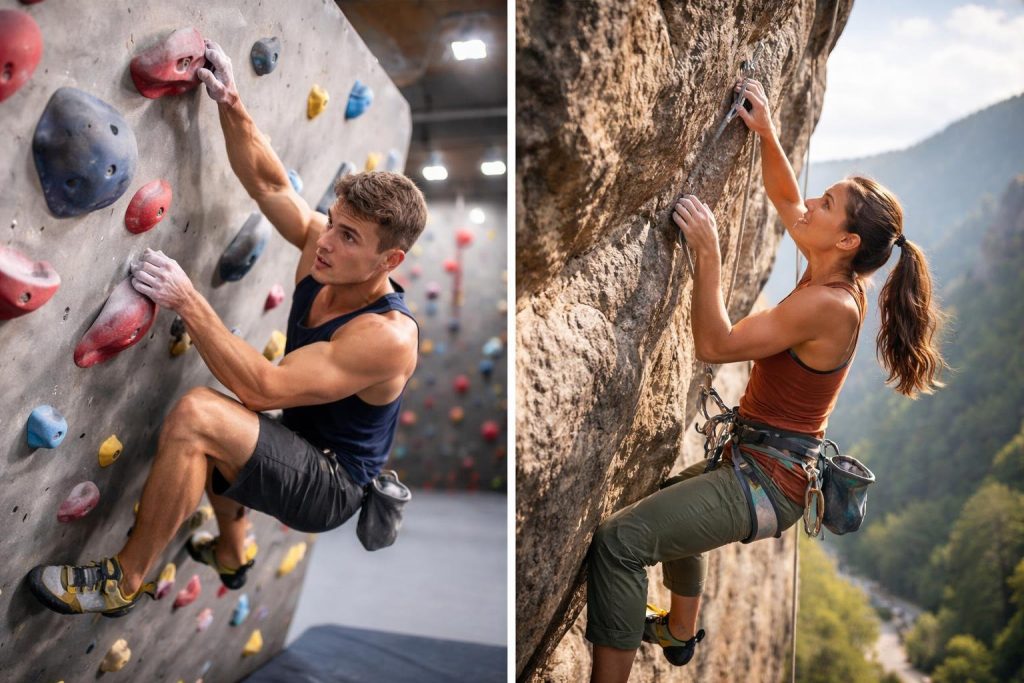
Bouldering involves climbing shorter walls without ropes, usually no more than 15 feet high. Each problem requires intense bursts of power and technical movement. Rock climbing covers longer routes with safety equipment and tests endurance over extended periods.
The difficulty between these two climbing styles depends on what a person finds challenging. Some climbers struggle more with the explosive strength needed for bouldering. Others find the sustained effort and mental stamina of rope climbing more demanding.
Key Takeaways
- Bouldering and rock climbing test different skills, rather than one being universally harder than the other
- Bouldering focuses on short, powerful movements, while rope climbing requires sustained endurance
- Personal strengths and weaknesses determine which climbing style feels more difficult for each individual
Is Bouldering Harder Than Rock Climbing?
Both styles demand different strengths and skills, making direct comparison challenging. Bouldering emphasizes short bursts of maximum effort, while rock climbing requires sustained endurance over longer routes.
Key Differences in Physical and Mental Demands
Bouldering requires intense upper-body strength and explosive power for short sequences. Each boulder problem lasts only seconds to minutes, pushing climbers to their absolute physical limits. The focus stays on maximum strength output rather than pacing energy over time.
Rock climbing demands endurance as the primary physical requirement. Climbers must maintain consistent effort for 20 to 100 feet or more. Body tension matters in both styles, but rock climbing tests the ability to hold positions while managing fatigue over extended periods.
Mental demands differ significantly between the two. Bouldering problems require problem-solving under physical strain, with climbers analyzing dynamic movements and crimps in compressed timeframes. Rock climbing challenges include route reading, fear management at height, and strategic rest positioning throughout longer climbs.
Exploring Bouldering Versus Rock Climbing Challenges
Bouldering challenges center on technical difficulty compressed into brief sequences. A single dyno or difficult crimp sequence can define an entire problem. Climbers attempt the same moves repeatedly, requiring specific strength training between sessions.
Rock climbing presents continuous challenges that test stamina and mental resilience. Routes combine multiple movement types, demanding versatility rather than specialized strength. The climbing technique shifts from powerful moves to efficient movement patterns that conserve energy.
Falls present different risks in each discipline. Bouldering falls happen from 12-15 feet onto crash pads, with ankle and wrist injuries being common. Rock climbing uses ropes for protection, making falls generally safer but introducing psychological challenges related to height exposure.
Comparing Required Techniques and Skills
Grip strength development differs between styles. Bouldering builds maximum finger strength through repeated attempts on small holds and crimps. Rock climbers develop moderate grip strength sustained over longer periods, focusing on efficiency rather than peak power.
Dynamic movement appears more frequently in bouldering. Explosive moves and controlled dynos require rapid muscle recruitment and precise body positioning. Rock climbing incorporates these movements occasionally but prioritizes smooth, static technique that minimizes energy expenditure.
Both disciplines require dedicated practice to progress. Bouldering sessions focus on strength training and projecting specific problems. Rock climbing training balances endurance building with technical skill development across varied terrain and holds.
Grading Systems and Difficulty Assessment
Bouldering and rock climbing use different grading systems to measure difficulty, though both sports require climbers to understand multiple international scales. The V-scale and Font scale dominate bouldering, while the Yosemite Decimal System and French scale are standard for rope climbing.
Understanding Bouldering and Rock Climbing Grades
Bouldering grades focus on the difficulty of short, powerful sequences without accounting for height or endurance factors. The V-scale (or Hueco scale) starts at V0 for beginners and currently extends to V17, representing the world’s hardest boulder problems. The Font scale, used primarily in Europe, runs from 4 to 9A and beyond.
Rock climbing grading systems measure sustained difficulty over longer routes. The Yosemite Decimal System (YDS) begins at 5.0 and progresses through 5.15d, the highest grade achieved. Each number after 5. indicates increasing difficulty, with letters (a, b, c, d) providing further refinement at harder levels.
The French grading system uses numbers and letters, starting at 1 and currently reaching 9c for the most difficult climbs. This scale accounts for technical difficulty, endurance requirements, and protection quality.
International Grading Scales and Their Interpretation
Different regions prefer specific bouldering grading systems, though most climbers learn to convert between scales. The V-scale dominates in North America, while European climbers typically use the Font scale. A V10 boulder problem roughly equals Font 7C+, though direct comparisons aren’t perfect.
Rock climbing grades vary more significantly between systems. A 5.14a in the YDS corresponds to approximately 8b+ in the French scale. Climbers traveling internationally must familiarize themselves with local grading conventions.
Grade comparisons remain subjective because climbing styles, rock types, and environmental conditions affect difficulty perception. A technical slab climb at 5.12a feels completely different from an overhanging 5.12a route, even though both share the same grade.